
“… but here, and you must feel it for yourselves, young people, here is the most truly alive youthfulness in the world. All phenomena, all humanity is to be recognized only in its fiery form, only in passion. For the intellect arises from the blood, thought from passion, passion from enthusiasm… Enthusiasm first, then diligence—enthusiasm giving you the finest, most extreme and greatest tutorial in the world…”
Stefan Zweig, Confusion
About a month ago, I got dumped for the first time in my life. (When I told him this as he was breaking up with me, he said “Really?!”) The morning after, I had a Courage Bagel with my just-then-ex-boyfriend, drove home, listened to Change by Alex G, cried, went on a run, showered, and then went to the Pasadena Erewhon to buy a Salmon Banh Mi Wrap ($17.50 without tax) and to write my manifesto.
A college boyfriend had introduced me to the practice of writing manifestos. We met in a class on Frege; I had thought he was cute, and that he had interesting things to say about Frege, both of which were welcome surprises in a class on analytic philosophy of language. On our first date, we sat next to a notably grotesque limestone fountain on campus, and he showed me a folder full of text files: new aesthetics, new, gleaming ways to look at the world, to inhabit it, maybe. The wonder in the manifesto-form, he explained, was that it wasn’t really a form. There were no constraints: the idea was not to be right, or to write something well, but to express an idea with the urgency it deserved. A manifesto could be a jar of fireflies, a way of trapping light.
I was determined. I took out my electric blue Leuchtturm pocket planner and my fountain pen, which is a Japanese children’s model in clear plastic. My first attempt looked something like this:
TO PRIORITIZE RIGHT NOW:
STUDY
DUMB PHONE
VOLUNTEER
MAKE FRIENDS IN LA
CONCERTS, FILMS, BOOKS. I NEED A BIG BOOK
SCROLLING
BEING HOT
DON’T DATE BUT HAVING SEX IS OKAY
CLEANLINESS
WRITING WRITING WRITING WRITING
I set the pen down and knit my brow at the Salmon Banh Mi Wrap. My determination began to dissolve. I had spent more than $50 on sandwiches and it wasn’t yet noon. I took a second and scribbled down, in frightful big letters:
HOW CAN I DO ALL THIS STUFF?
This is the anxiety haunting the self-improvement plan, the form my manifesto had begun to assume. The self-improvement plan tells us that even if we are deficient in X, Y, or Z ways, that we can be rendered perfect by grit, determination, and faith in the transformative power of planning. Planning, our way of provisioning against time, lets us tell ourselves “not today, but 6 months from now, a year from now, 5 years from now.” But the reality the self-improvement plan has to contend with, however perfect a future it promises is that we are finite, dependent creatures. We are subject to the whims of fate and of each other, no matter how early we rise, how many grams of protein we consume, or how well we manifest.
If the self-improvement plan is founded in a deep human anxiety about our own finitude and incapacity, it should come as no surprise that it finds its origins in our distant past. Earlier this year, I read Hesiod’s Works and Days, which was written around the time of Homer, an example of what classicists call wisdom literature. In this case, the wisdom of the ancients turns out mostly to be about threshing your corn properly and avoiding uncharmed pots. A closer relative to my manifesto might be Ben Franklin’s “plan for attaining moral perfection,” a title which is almost as perfect as the stated purpose of the plan, which is “live without committing any fault at any time.” (Me too, Ben.) Franklin’s plan involved the development of 13 virtues over 13 weeks (some representative examples: “Tranquility: Be not disturbed at trifles” “Chastity: Rarely use venery but for health of offspring - never to dullness” “Humility: Imitate Jesus and Socrates”). Crucially, he failed to attain moral perfection: he apparently did not practice Chastity particularly well, nor did he ever become a particularly good chess player like he set out to be. So, if Ben Franklin’s plan didn’t work for him, how was I supposed to stick to mine?
A shudder of embarrassment overtook me: I had recreated an honest-to-god self-improvement plan. It is of course deeply uncool to buy into self-help, which is on one hand tantamount to admitting that you are so incapable that some defect in your own life is better left as the domain of other, more capable people, and on the other, to taking your failures so seriously at a time when stylish imperfection is the hallmark of chicness-as-morality. I remembered when a high school friend had told me that he was doing something called 75 Hard, which I learned against my will involved working out twice a day, drinking a gallon of water, and reading 10 pages of self-help for 75 days. This was apparently supposed to fix your life.
It all felt extremely Male, and fundamentally unlivable. The conventional self-improvement plan was about removing imperfection from your life, incapable of sitting with it; it was about starving yourself, about torturing yourself, about turning yourself into an iron cage of a person. It was pathetic in its attempt to rebel against the fragility of life, it was fundamentally materialist, in that it affirmed the body alone, and it was puritanical, in that it did not just deny but negated pleasure, relishing in being “hard.”
However far back it goes, the self-improvement plan has limits. One classic objection to self-help is that it is not actually helpful. For one thing, there are clear limits on what you can achieve with such general advice. Something like wisdom literature can get you to thresh your corn at the right time of year, which is helpful if you’re a farmer in 8th century Greece. Something like Benjamin Franklin’s plan can probably get you to rarely use venery if you have sufficient self-discipline, and possibly to be not disturbed at trifles (Deirdre McCloskey calls him the patron saint of prudence), but it’s not particularly helpful in a non-prudential sense, that is, outside of setting the boundaries of what you allow or prohibit yourself from doing. Imitate Jesus and Socrates — but how? And then, even if I do know how to accomplish my goals, how do I know they’re the right ones? Why Jesus? Why Socrates?
We can think of two kinds of reasoning about what to do, the kind of means-ends reasoning where I take a set of goals I already have and ask myself how to reach them, and reasoning about ends where I ask myself whether the goals I have are any good. The second kind is a lot tougher, and it’s the one I had to engage in here. My still-untouched Salmon Banh Mi Wrap continued to taunt me. I finally took a bite.
Suddenly, I remembered a conversation I had with a philosopher friend a couple of weeks before. She had been sleeping with a grad student who was clearly not over his ex back in Australia. I told her she shouldn’t keep seeing him. To sleep with someone emotionally divested in you would open up a deficit of self-respect, even if it was pleasurable in the moment, and that momentary pleasure was likely to give way to future pain; weighing the two, the pain usually was worse than the pleasure. (In hindsight, this was probably more reflective of my own neuroses than anything else.) My friend, a self-proclaimed Spinozist, responded that Spinoza wrote in his Ethics that pleasure was whatever increased one’s own power. But then, I responded, is sleeping with this guy increasing your power? We both laughed.
I hadn’t read much Spinoza, but it seemed significant to me that he came to mind. What I remembered of him made him seem humane and eminently respectable: he wrote in mathematical propositions, in the style of a proof. He was a theist, Jewish, but was excommunicated and had to take exile in the Netherlands. Deleuze had written a famous monograph on him, which I had read years ago and retained nothing of.
I began to wonder if I had stumbled onto a more attractive mirror image of the conventional self-improvement plan. Where the conventional self-improvement plan was burdened with rules to the point where the likes of Ben Franklin could not keep up with them, my friend’s Spinozism-for-Dummies was as simple as could be — there was only one maxim, to increase one’s power. And then, while self-improvement and self-help, I thought, were basically for stupid people, Spinoza was not. Spinoza had a patina of intellectualism, the weight of centuries behind him. My advisor in undergrad had written a thesis on Spinoza, my friend whom I respected was a Spinozist, maybe Deleuze was a Spinozist, if he was an -ist at all.
But most of all, I found the plan attractive exactly because I felt powerless, unfree. Being in an unhappy relationship tends to diminish one’s power, but being broken up with in an unhappy relationship, to have a thing taken from you that you’re not even sure you want, is special. I would no longer be a baby bird tipped out of its nest, a sniveling, dependent mess. Neither would I try to be an immovable mass of a man, a cold-hearted son-of-a-bitch. What did it mean, even, to increase one’s own power? I immediately went on my phone and ordered a copy of Spinoza’s Ethics. While I waited for it to arrive, I figured that I could figure it out on my own. I would be a Spinozist for the next few weeks, or whatever I understood of being a Spinozist without having read him. And I would increase my own power, whatever that meant.
My Spinozist Post-Breakup Self-Improvement Plan began that same day. After mulling over my manifesto and studying for a couple of hours (power increased), I went out to meet some friends. I saw my cat ears on the dresser and put them on (power increased), met some friends for dinner with the cat ears on (power questionably increased), went to a concert still with the cat ears on (power increased). I turned my phone off, I had a BuzzBall for the first time (power increased). On the way home, I stopped at Akbar, let myself get hit on, but didn’t linger (power increased). I booked pilates and volunteering for 9am (power, again, increased). Things were, as far as they could be, good.

The next couple weeks continued in much the same way: everything I did, everything that happened to me, was entered into a mental double-entry bookkeeping of increases and decreases of power. There was no underlying rigor to this: as long as I continued to wait for my book to arrive in the mail, I figured that whatever increased my power was probably equivalent to whatever I felt would increase my power. And often, this calculation was straightforward enough. I got a dumb phone, I stopped scrolling. I went to Skid Row, I volunteered, I helped a guy get off of crack and into detox. My power increased: I felt more capable, that I had uncovered some secret region of action that I had been previously unaware of. And I felt pleasure, which was the bodily mark of having increased one’s power according to Spinoza.
On the other hand, I thought about my ex-boyfriend, a lot. My power decreased: the thought of him would literally paralyze me, causing me to stutter in the middle of a sentence, or to forget what I was doing — but then the alternative would be to try to withhold those memories, decreasing my power even more trying to dam away memories. Anger, too, was off the table: to expend effort towards trying to repair or refuse some harm felt useless when harm was something I could not keep from happening to myself. (From my diary: “Is it better to coldly reject or to accept heartfully? Anger seems bad either way, and I’ve had a lot of it. Power decreased. Look up what Spinoza thinks about anger. Meditated + read before bed.”)
An underlying logic seemed to emerge in the absence of any actual guidance. Imagination, judgment, and will were my tools here: imagination let me envision what might increase my power, or let me get out of my situation. And without the imagination that allows one to escape from conventional notions of what power is, this plan would be the conventional 75-hard-style self improvement plan, or the raw meat, no masturbation, etc. improvement plan, or the Nietzschean Vitalist coke-and-burgers self-improvement plan. (At the same time, our imagination is always more limited than we think it to be. My plan, while consciously being a rejection of conventional masculinist self-improvement, involved a dumb phone, muesli, and lots of exercise. When I tried to explain it to one friend, she called it Elizabeth Holmes-ian.)
Judgment allowed me to make comparisons — this will increase my power more, this will increase it less, this will diminish it (notice how this differs from conventional judgment of good versus bad — there is a two-way vs 3-way comparison, where there is something preferred, something acceptable, and something unacceptable).
And then the will, which was hypertrophied in these other schemas, was still not neglected: for something to increase my power of acting, it seemed reasonable that it had to be something I could actually do. It was precisely the capacity to imagine, judge, and will my way to a better life that would allow me to escape the drudgery of conventional self improvement while at the same time being able to move towards a life that was more full, a world that was more capacious.
And as I imagined, judged, and willed it, so my world seemed to become more capacious. I gave my ex-boyfriend the fingerless gloves I had bought him for a Christmas present, and a letter; we agreed we’d try to stay friends. I wrote more letters to friends. I began to see a Lacanian analyst who made me write down my dreams. I went up the coast for Thanksgiving, I had old friends visit, I drove all over Los Angeles with my dumb phone, taking the temperature of the streets, listening to the radio, the hum of the air conditioner. I took my exams and did well. I felt more grateful, balanced, and intelligent; more passionate, freer. Things were beginning to seem unqualifiedly good.
The morning that my exams were over, I opened my mailbox to find a copy of Spinoza’s Ethics (I did not realize the edition I got would be so ugly). I had a plan. I would go to Wi Spa, read Spinoza’s Ethics, work on this piece, go have a glass of wine with a guy I had been texting, and drop off the air mattress I had borrowed from my ex-boyfriend. This all seemed like a great plan. I would be accelerating the process of taking care of myself, I would learn, I would have a chance at making a new friend, and I would prove to myself that I was over my ex-boyfriend.
On the third floor of Wi Spa, there’s a sauna room filled with little clay balls. This is the best room to read in that I’ve found in Los Angeles, even though it says you can’t bring a book in there for some reason (it’s a dry heat!). You stumble across a plank that launches you into a sea of these little terracotta balls — there is no elegant way of getting in — and you lay down and get very hot and read feverishly, with a passion only accessible through a change of bodily state. And so I began reading in the clay ball room, sweating through the pages, warping them, destroying them with a hunger, a rapacity to figure out how I ought to live. Within twenty minutes I understood that I had been running a con on myself.

The cocktail-party Spinozism I had taken from my friend said something like: pleasure signals power, therefore pursue pleasure, therefore you are becoming free. This was, I now realized, almost perfectly wrong. Spinoza’s actual claim is that we are constitutively terrible judges of what increases our power. “The infant believes he freely wants the milk; the angry child that he wants vengeance; and the timid, flight. So the drunk believes it is from a free decision of the mind that he speaks the things he later, when sober, wishes he had not said.” We feel ourselves to be free because we are conscious of our desires and ignorant of their causes. The feeling of freedom is the surest sign of bondage.
I had spent weeks keeping a mental ledger — power increased, power decreased — as though I were a kind of emotional accountant, tallying my way toward liberation. But the ledger itself was the problem. Every entry was a passion in Spinoza’s technical sense: an affect of which I was not the adequate cause, a response to some external thing acting upon me. The cat ears, the BuzzBalls, the Akbar flirtation, even the volunteering — none of it was action in Spinoza’s sense. I was not steering, I was being buffeted. The bookkeeping just gave the buffeting a shape, a story, a sense of trajectory. It allowed me to feel like I was doing something while I was, in fact, being done to.
And then what Spinoza says about those torn by contrary affects: “they do not know what they want, and those who are not moved by any affect are very easily driven here and there.” This was the clinical description of my condition. I did not know what I wanted. I wanted to be over him; I clearly wanted him back. I wanted freedom; I wanted to be held. I wanted to increase my power; I wanted to collapse into someone else’s. The plan was not a solution to these contradictions. It was a way of not looking at them directly.
Part IV of the Ethics is titled “Of Human Bondage, or the Powers of the Affects.” Part V is “Of the Power of the Intellect, or on Human Freedom.” I had been living entirely in Part IV while believing I had skipped ahead to Part V. Spinoza’s freedom is not a feeling. It is not something you can produce through accumulated pleasures or acts of will. It comes only through forming clear and distinct ideas—understanding the causes of your affects so thoroughly that they cease to be passions and become something else, something you can call your own. “An affect which is a passion,” he writes, “ceases to be a passion as soon as we form a clear and distinct idea of it.”
I had no clear and distinct ideas. I had a dumb phone and a muesli and BuzzBall habit and a ledger full of confused impressions I had mistaken for insight.
I went to the bar nauseous and full of dread. This was, I now understood, a passion of which I was not the adequate cause, my body’s power of acting diminished before I had even ordered a drink. I ordered a glass of “crisp mineralic white” and opened my Italo Svevo stories, which I had brought in service of a fantasy that someone at this wine bar in Los Feliz would know or care who Italo Svevo was. I couldn’t read a single sentence; the words slid off the page. My power! What about my power?
My date arrived. I hadn’t remembered what he looked like from when I got his number. Apparently, he had a weak chin and curly hair, and eyes I wasn’t sure were blue or brown. He ordered the same wine I had, and he emphasized his Ls, curling his tongue back deliberately when he spoke, as if to make the presence of a letter a site for some faux-affable irony. All this I found damning. He finished his glass quickly and asked if I wanted another. I said sure. This was the first of six.
By the fifth glass I was sloppily making out with him on the terrace, trying to feel something and only feeling the trying. By the sixth he was repeatedly telling me he had “promised himself he wouldn’t go home with me tonight.” I told him that I lived in Pasadena, anyways. We were yelling, or he was yelling, or we had both raised our voices in that way that isn’t quite yelling but is worse, somehow —
And then he was gone. Stormed off. I sat there with the dregs of my wine and my unread book and my dumb phone, which I had been using throughout the date to text my ex-boyfriend, letter by letter, like a child forced to copy out a sentence as punishment: o-k r-e-a-d-y w-h-e-n-e-v-e-r y-o-u a-r-e, and hit send. My dumb phone chirped back at me immediately: “yea come over.”
I went to his apartment without hesitation. I walked past the Children’s Hospital, the Scientology Media Production Center. It was only a few minutes away. It was always only a few minutes away. I stumbled to the door with the air mattress under my arm like some perverse housewarming gift. He asked me if I wanted to come in and sit.
He had been working on a song, and I tripped over the microphone that was standing in the middle of his studio. We talked. I don’t remember about what; I had had six glasses of wine and no dinner, I just remember that he looked tired, and that he was drinking a cup of tea. At some point I wandered into his kitchen and tried to make myself a cup of chamomile tea, which required opening three cabinets I had once known the contents of by heart. The kettle was the same kettle. The mug was the same mug.
I stood there with the tea, vegetal and piss-warm in my hands, and realized, with the clarity that only comes when you are too drunk for it to help any, that I was here. That I did not want to be here. That every decision I had made in the last two weeks had been in service of not being here, and yet here I was, in his kitchen, at midnight, holding a mug of chamomile. My Spinozist self-improvement plan, the house of theory I had come to inhabit, had collapsed on top of me.
He told me he had to get back to work, but that I was too drunk to drive home, and offered to call me an Uber. I said no. I couldn’t tell you why—maybe it was some last shred of dignity, of wanting to do one thing that was mine—but I walked out to my car, reclined the driver’s seat as far as it would go, and slept. The steering wheel dug into my shoulder. My back seized up sometime around 3 a.m. I closed my eyes for a couple of hours and pretended to sleep, just as I had done for the last two weeks since we broke up. I thought of things that I knew to keep my thoughts at bay: the square root of 169 was 13. The capital of Botswana was Gaborone. Ankunft meant arrival in German.
In the morning I drove to Griffith. I hiked up Hollywood Peak under the angry sun. As I arrived at the top, through a hangover that felt like cosmic punishment, I looked out over the city.

A memory from the morning after we broke up came back to me. I was sitting on my ex-boyfriend’s toilet hunched over with my head in my arms and I noticed a jug of pink Hibiclens disinfectant lurking underneath the bathtub from the corner of my eye. In my volunteer work, we used it almost every day, but I just thought of it as pink stuff. Chlorhexidine — what did it do? I sat there, I thought about it, and I did nothing. I sat in the wonder, at the top of the mountain.
I’m still not sure how much I learned from all of this. Spinoza says freedom comes from forming clear and distinct ideas, but what if we lack the capacity? What if our ideas make us more unfree? What if we don’t even want freedom—what if we want, against all reason, to be bound, to be held?
The temptation is to say there’s always an escape, a way out of whatever trap we’ve made for ourselves. But our freedom is not entirely up to us. It is guaranteed by other people, and sometimes they refuse. We are finite, dependent beings. In such circumstances, maybe the only thing to do is what St. Silouan said: keep your mind in hell and despair not.
I still love resolutions, against my better judgment. Every year I make the same ones: follow my passion, develop my intuition, chew my food properly, stand up straight. This year I’m adding one more: cultivate curiosity.
I have two touchstones for this. One is something Shulamith Firestone wrote, which I’ll leave below. The other is my Hibiclens memory— when I got back down, I looked it up. Now I know that it binds to bacterial cell walls, that it prevents the further growth of bacteria, that it doesn’t kill them. I know something now that I didn’t know a few weeks ago.
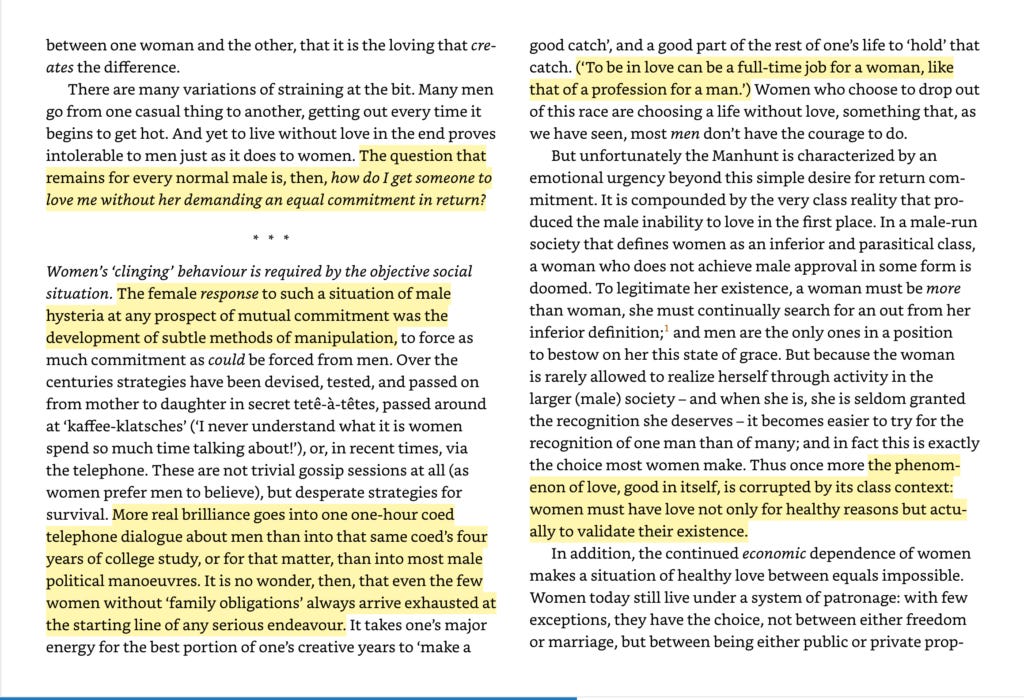
Maybe that seed is enough. Maybe that’s the place we failsons and faildaughters of postmodernity can start to eke out our own freedom — not through any grand liberation as promised by a Plan, but the small, stubborn act of wanting to know what’s under the bathtub. Curiosity as survival. Curiosity as the thing that remains when the house of theory collapses around you.
Happy new year, everyone! I hope this one we all chew better, stand up straighter, and make better choices. I hope you and I are both more curious. I’ll leave you with this (RIP, Rob Reiner). “Anyways, it’s about old friends.”
the algo has done its job -- at last -- and led me to this
thank you for transmuting your suffering into an excellent & funny intro to Spinoza—I loved this and so many small humorous moments! (like “It all felt extremely Male, and fundamentally unlivable”)